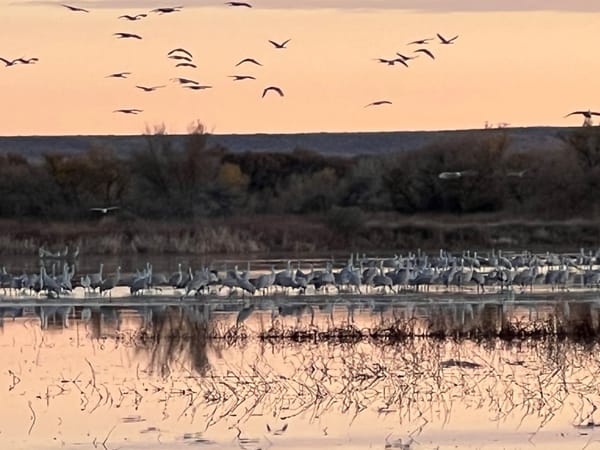
The Last Refuge
A surprise, end-of-year review at the U.S. Fish and Wildlife Service could signal major changes are underway at our refuges
The year 2025 was a consequential one for America's public lands. Trying to catalog every threat that emerged in the last 12 months—from plans to sell off millions of acres, to the rapid expansion of oil-and-gas leases, to the attempts to gut the Endangered Species Act—would be a daunting task. I was going to write "impossible task," but our friends at More than Just Parks managed to do it, producing an impressive (and depressing) end of year list published on January 1. By their count, some seventy consequential decisions were made by the current administration since last January—but one could argue that even that exhaustive list overlooks a few items.
It was nice, then, to enjoy the unusually quiet period at the end of December, when one could reasonably expect little of consequence to emerge out of Washington during the weeks of Christmas and New Years. With Congress on recess and most American companies taking a welcome two week pause, it was even understandable to imagine that it would OK to take our collective eyes off the ball for a few days and enjoy a brief respite.
But the Department of Interior doesn't shut down like a lot of companies this time of year; its employees only get federal holidays off. And if an under-the-radar, late-year agency memorandum is any indication, the folks at the U.S. Fish and Wildlife Service (USFWS) weren't sitting by idly while the rest of us slugged egg nog and watched bowl games. Instead, many of them have been deep in the weeds, analyzing every aspect of their organization to look for "efficiencies."
On December 16, just before the rest of the country went into its brief hibernation, director of the USFWS, Brian Nesvik, ordered his staff to undertake a "comprehensive review" of the National Wildlife Refuge System and National Fish Hatchery System. In his memo, Nesvik laid out the "required components" of this review, due early this month, which include analyzing:
- Overall mission of the bureau and NWRS and NFHS alignment; look for refuges or hatcheries established for a purpose that no longer aligns with the mission
- Organizational structure required to achieve the mission of the NWRS and NFHS, including existing barriers and opportunities to remove those barriers
- Current resources (both operational funding and workforce)
- Refuge and hatchery staff capacity to build and maintain relationships and ability to work in partnership with local communities and State and Tribal wildlife management agencies
- Consistent, transparent policy and guidance to ensure system-wide land, water, and resource management
- Asset and infrastructure management with a particular focus on accurate deferred maintenance assessments and actual maintenance needs; and
- Opportunities to achieve efficiencies in the areas of governance, oversight, and span of control.
Now, it's important to note that agency reviews are not uncommon—and not automatically cause for raising a red flag, either. Any organization, government or otherwise, can benefit from a review of its operations, especially if the primary goal is improving effectiveness.
Routine improvement doesn't appear to be the motivation here, however, and the immediate tell is the timing. Unless you want something to remain under the radar, one doesn't normally order a review of this magnitude right before the rest of the country, including a lot of media members (like, say, those at RE:PUBLIC, who exclusively cover public lands) are about to go on vacation and won't be paying close attention. Nor do bosses typically assign a due date for major work that requires burning the midnight oil during the holidays—unless their name is Ebenezer Scrooge.
In this case, some of the preliminary work outlined in Nesvik's memo is due January 5, the same day most of the country will be collectively shaking off the post-holiday haze and wanting to declare email bankruptcy.
More troubling is the undeniably ominous language in some of those aforementioned bullet points. Namely: numbers one ("look for refuges or hatcheries established for a purpose that no longer aligns with the mission") and seven ("achieve efficiencies in the areas of governance, oversight, and span of control"). The former sure makes it appear that the Department of Interior is looking to cut some wildlife refuges, especially since we're not certain exactly what the agency's intended mission is beyond energy dominance. And the latter? Well, anyone who has spent time in the corporate world knows that when leadership begins talking about "achieving efficiencies," it can only mean one thing: it's time to start polishing your resume because layoffs are undoubtedly coming.
This memo is troubling for a lot of reasons, but to understand why, it's helpful to review the role wildlife refuges play in our interconnected web of public lands. After all, of the four main types of federal public lands, the National Wildlife Refuge System is probably the least well known and understood by most Americans. Their establishment can be traced back to President Theodore Roosevelt. In 1903, he designated Pelican Island in Florida as the nation’s first federal bird refuge.
At the time, hunting and the plume trade were decimating bird populations, and Roosevelt—often acting over the objections of states and industry—used executive authority to set aside land specifically for wildlife protection. Over the following decades, additional refuges were created through executive orders, congressional acts, and land set-asides tied to waterfowl conservation, particularly along major migration routes. Today, the system includes more than 560 refuges covering roughly 95 million acres.
National wildlife refuges are essential because they are the only federal public lands system created explicitly to put wildlife first. Their core purpose is to protect habitat for fish, birds, and other animal life—especially migratory species that depend on intact landscapes across state and international boundaries. Refuges safeguard breeding grounds, wintering areas, wetlands, deserts, and coastal ecosystems that are essential to biodiversity and clean water. Many refuges protect habitat for endangered and threatened species, and they play an outsized role in waterfowl conservation and migratory bird survival across North America.
What makes refuges distinct is their legal mission and management standard. According to a law established by Congress in 1997, all uses of refuge lands must be deemed “compatible” with the primary purpose of wildlife conservation. Activities like hunting, fishing, grazing, energy development, or recreation are not automatic rights; they are allowed only if managers determine they won’t undermine wildlife or habitat. This sets refuges apart from lands like national forests or Bureau of Land Management lands, which operate under multiple-use mandates that explicitly balance conservation with resource extraction and commercial uses. Refuges are often quieter, less staffed, and less visited than national parks. Their importance lies in the unglamorous, essential work of keeping ecosystems intact so wildlife can survive.
Most national wildlife refuges operate with very small permanent staffs, often just one to three full-time employees responsible for managing tens or even hundreds of thousands of acres. Some refuges are managed remotely by staff based at other units because they don’t have on-site personnel at all. (Indeed, I have been told by public-lands experts, unprompted and on multiple occasions, that RE:PUBLIC should do a story on the staffing shortages at these refuges.)
The core reason is funding. While the National Wildlife Refuge System is the world’s largest network of lands dedicated to wildlife conservation, it has historically received far fewer dollars per acre than agencies like the National Park Service or the Forest Service. And staffing levels have not kept pace with land acquisitions, expanded public access mandates, climate impacts, or invasive species pressures. As a result, refuge managers often have to prioritize crisis response over long-term conservation planning.
And this is what is particularly concerning about December's "comprehensive review." In 1997, the National Wildlife Refuge System Improvement Act established wildlife conservation as the system’s primary mission. If this review is intended to see how our refuges "align with the mission," one has to wonder if this administration has in mind a different mission altogether. What's more, if they are looking to assess current resources and capacity, we can probably guess the key finding: the agency has neither the personnel nor capacity to properly execute the mission of wildlife refuges. And if that is the inevitable conclusion, it is also reasonable to expect that the current leadership will argue that we need to get rid of some of our refuges because, well, we no longer have adequate money or staff to manage them.
I'd prefer not to be so cynical about the review's intentions. And, to be fair, we won't really know anything until they publicly release the list of refuges that are deemed no longer in alignment with the U.S. Wildlife Refuge System's mission—i.e., the initial list that is due on Monday, January 5.
But then I think back to that other list I mentioned, the one cataloging all the decisions made around public lands by the Trump Administration last year. That one includes these seven items that directly pertain to the management of critical wildlife habitats and refuges:
- Issued a day one executive order to “unleash” extraction in Alaska, explicitly targeting the Tongass National Forest and the Arctic National Wildlife Refuge by tearing down long-standing public-land protections across millions of acres.
- Announced plans to wipe out conservation safeguards on 13 million acres of Alaska’s Western Arctic, sacrificing one of the most wildlife-rich landscapes in North America—caribou calving grounds, polar bear habitat, subsistence lands—to oil drilling.
- Revived the rejected Ambler Road mining project in Alaska by directing steps to approve a 211-mile private industrial road through the Brooks Range and Gates of the Arctic National Park, a route that would cut across 11 major rivers and 3,000 streams in pristine wilderness.
- Removed a 2024 drilling ban in Nevada’s Ruby Mountains, reopening this iconic recreation and wildlife area to oil and gas leasing after it had been slated for long-term conservation.
- Ordered the entire 1.56-million-acre coastal plain of the Arctic National Wildlife Refuge to be opened for drilling and mandated new lease sales in the Western Arctic, erasing habitat protections outright.
- Reinstated voided oil leases in the Arctic National Wildlife Refuge that had been canceled in 2021, restoring leases held by a state-owned corporation (AIDEA) and clearing the way for drilling to proceed in the refuge despite unresolved legal and environmental concerns.
- Proposed a 2026 budget that gutted parks, forests, and wildlife refuges by more than a third.
You don't have to look too closely to see the pattern, and it's one that warrants cynicism. Simply put, those are not the policy choices of an administration interested in aligning existing refuges with their intended—and legally defined—mission of protecting wildlife. And we can therefor only assume it's something much more troubling than that.
The Good, the Bad, and the Ugly
Every Friday, our team shares critical stories about public lands from around the internet. This list could be exhaustive and exhausting, but our intent is to inform, not overwhelm. Instead, we choose three to five important stories you should be aware of—including at least one piece of good news.
The Good: How a Left-Right Social Media Tiff Pushed Texas to Fund Parks “Texas is known for its deep devotion to private ownership and staunch aversion to government spending. So why, for much of the past year, has the state been on a land-buying spree to expand its park system? The answer might seem like a one-liner: A Republican megadonor and an environmental activist got into an argument on social media about the role of wind turbines in harming birds.”
More Good: Montanans Shrug at Government Request to Report Signage that 'Rewrites' History "In the summer, QR codes were posted across public lands in the United States, including Montana, asking visitors to report any government signage that ran afoul of President Donald Trump’s executive order titled “Restoring Truth and Sanity to American History.” The QR codes posted on Bureau of Land Management properties asking Montanans to be a part of this effort to restore truth and sanity mostly met an unreceptive audience in the state, according to records from this summer obtained by the environmental group Sierra Club. All names were listed as anonymous in the obtained records."
The Bad: BLM Opens Sage-Grouse Habitat Development “The Bureau of Land Management announced last week updated plans for access to public lands for 'responsible' energy and mineral development across Idaho, Montana and the Dakotas, Nevada and California, Utah and Wyoming. However, the plan has those working to protect the West’s most iconic bird looking to the courts to stop incursions into greater sage-grouse habitat. The plan gels with President Donald Trump’s Unleashing American Energy Executive Order written last January and the Interior Department's National Energy Independence Order which directs the 'removal of impediments imposed on the development and use of our nation’s abundant energy and natural resources by the Biden administration’s burdensome regulations.'"
The Ugly: Alaska’s $44 Billion Bet on Natural Gas “Proponents like Alaska Governor Mike Dunleavy extoll the economic benefits the pipeline will bring to Alaska and the energy security it will provide to allies. But the cost is staggering: Official estimates put it at $44 billion, though independent analysts suggest it could top $70 billion. Experts say it has required substantial government support to develop and will require 'a mix of public and private capital to move forward.' ... Glenfarne Group, a privately held energy firm that has never operated a liquified natural gas export terminal, stepped in last year. Shortly after Trump was elected, state officials handed the company a 75 percent stake in the project in a no-bid deal, the details of which have been kept even from the legislature.”